The reason best AI marketing tools feel “everywhere” in 2026 is simple: marketing output expectations kept rising while teams and budgets did not. HubSpot reports that 80% of marketers use AI for content creation and 75% use it for media production, which tells you where the pressure is landing: volume and speed. The winning teams are not collecting shiny apps. They are building a workflow where AI drafts, edits, versions, tests, and measures, while humans do strategy, taste, and accountability.
What are AI marketing software and AI marketing tools
Most marketing “tools” used to mean dashboards, schedulers, and analytics. Now it can also mean systems that generate assets, predict outcomes, and adapt content based on performance. That is the practical definition of AI marketing software: tools that automate or enhance marketing work using machine learning, generative models, or predictive algorithms.
A useful distinction: automation is rules; AI is judgment at scale.
- Traditional automation: “If the user clicks, send email A.” It is deterministic and only as smart as the flow you built.
- AI-driven work: “Write three subject lines for this audience, predict which one is stronger, then propose variants for testing.” It can create and adjust, not just route.
AI is changing marketing processes in three ways:
It reduces production friction. You can go from idea to first draft to multiple variants faster.
It shifts marketing from “one creative” to “a system of experiments”.
It forces teams to standardise inputs: brand voice, visual rules, and campaign structure.
And yes, it is becoming mandatory because the competitive baseline moved. When a competitor can produce ten ad variants in an afternoon, you cannot treat iteration as a monthly ritual.

Why marketers use AI tools for marketers
People do not adopt tools for fun. They adopt them because the work is endless and the calendar is cruel. The best reasons to use AI tools for marketers are not “because AI is cool”, but because the benefits show up in day-to-day operations.
Faster content production
AI helps you draft landing copy, email sequences, ad variants, blog outlines, and social captions quickly, then refine them with human judgment. That speed matters when campaigns move weekly, not quarterly.
Budget efficiency
If AI reduces the time it takes to get to “good enough to test”, you spend less on repetitive drafting and more on strategy, distribution, and high-impact creative. The cost savings are most obvious for small teams that need agency-level output.
Marketing at scale
Scale is not only “more ads”. It is more segments, more creatives, more channels, and more tests. AI makes scale manageable by making variation cheap.
Routine task automation
The boring parts are where time leaks: campaign naming, reporting, asset resizing, copy formatting, UTM hygiene, and content repurposing. AI and automation tools can handle those with consistent rules.
Higher efficiency and ROI
AI improves ROI when it supports better decisions: faster experimentation, clearer reporting, tighter brand consistency, and fewer broken workflows. “More content” is not the goal. Better performance from focused iteration is.

Categories of AI tools for digital marketing
No single tool will cover the whole funnel. The clean way to pick a stack is by category, then by workflow fit.
AI copywriting and AI content marketing tools
Use these for drafting, repurposing, and testing language.
Best for:
- ad copy variants (hooks, CTAs, headlines)
- email subject line testing ideas
- landing page sections and FAQs
- blog structure and content briefs
Reality check: copy tools are best when your inputs are structured (offer, audience, pain point, proof). If you feed them fluff, you get fluff.
AI image and creative generation tools
This category powers on-brand visuals for ads, social, landing pages, thumbnails, and campaign assets.
Best for:
- ad creatives and A/B variants
- product mockups and hero visuals
- background replacement and clean-ups
- consistent style across campaigns
AI video marketing tools
Video is now the default format for attention, but it is also the fastest way to burn your team out. AI video tools help you script, edit, subtitle, and create multiple platform-specific cuts.
Best for:
- short-form video variants (Reels, Shorts)
- captions, hooks, and pacing edits
- basic motion graphics and ad formats
AI marketing automation tools and workflow tools
These tools connect the pieces: publishing, routing, segmentation, lead nurturing, and campaign operations.
Best for:
- automated publishing and scheduling
- lead routing and follow-ups
- multi-channel campaign orchestration
- repeatable “brief to assets” pipelines
AI analytics and optimisation tools
Analytics is where many teams drown. AI can help summarise performance, suggest tests, and flag anomalies.
Best for:
- performance summaries in plain language
- audience segmentation insights
- optimisation suggestions for ads and emails
- anomaly detection (sudden drop, tracking issues)
Top best AI marketing tools for 2026
Most lists pick tools like they are Pokémon: “collect them all”. That approach creates chaos. The goal is a small, reliable stack that covers content, creative, publishing, and measurement.
Below is a comparison table of widely used tools, including Phygital+, with practical parameters teams actually care about.
| Tool | Main function | Automation level | Fits small business | Fits AI tools for marketing teams | Scalability | Implementation complexity | Cost |
|---|---|---|---|---|---|---|---|
| ChatGPT | Copy drafts, messaging, briefs, ideation | Medium | Yes | Yes | High | Low | Free–Paid |
| Jasper AI | Brand-aligned copy + templates + workflows | Medium–High | Yes | Yes | High | Medium | Paid |
| Canva AI | Design templates, social assets, quick edits | Medium | Yes | Yes | High | Low | Free–Paid |
| Runway | Video creation and editing workflows | Medium–High | Sometimes | Yes | High | Medium | Paid |
| HubSpot AI | CRM + marketing automation + content support | High | Sometimes | Yes | Very high | Medium–High | Paid |
| Phygital+ | Visual generation, editing, pipelines, consistency | Medium–High | Yes | Yes | High | Medium | Free–Paid |
How to read this table:
- If your bottleneck is writing and messaging, start with ChatGPT or Jasper.
- If your bottleneck is design output, Canva AI is the fastest on-ramp.
- If your bottleneck is short-form video, Runway helps you ship consistently.
- If your bottleneck is lifecycle and automation at scale, HubSpot’s ecosystem matters.
- If your bottleneck is on-brand visual production across channels, Phygital+ helps you standardise and scale.
How to build an AI marketing workflow
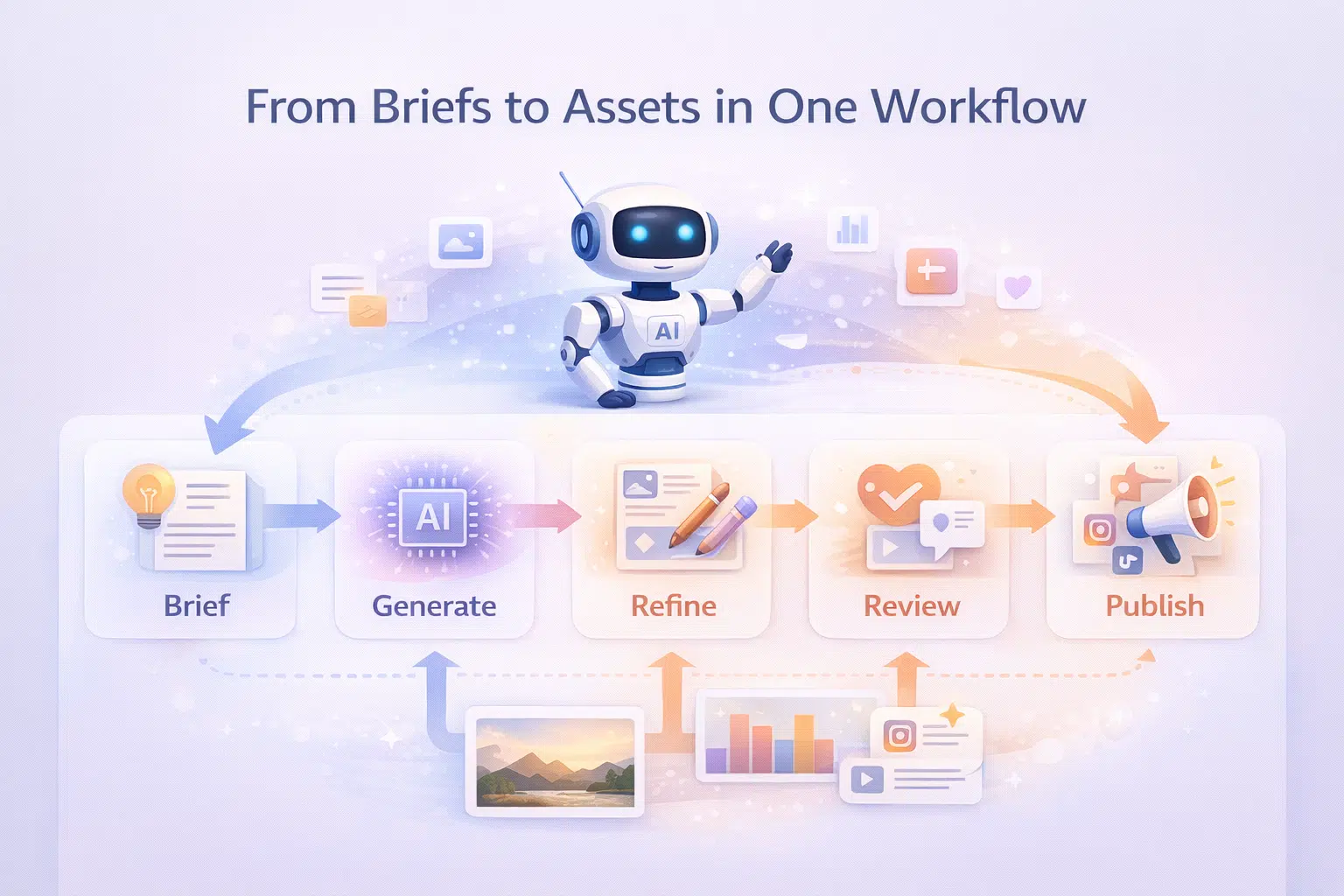
Using AI “sometimes” is easy. Building a workflow is what makes it reliable. A good workflow has inputs (brief, brand rules), outputs (assets, variants), and feedback loops (performance data).
AI generates content
Start with a structured brief:
- audience + stage (cold, warm, retention)
- offer and promise
- proof (testimonial, data point, product feature)
- constraints (tone, banned claims, legal lines)
Generate:
- one “core” message
- 5 headline variants
- 3 CTA options
- a short and long version of copy
Then apply human judgement: remove exaggeration, keep it accurate, align with brand voice.
AI creates visuals
Build a visual system, not random images.
- set a small set of styles (colour palette, composition rules, typography rules)
- define reusable layouts (carousel template, ad template, story format)
- generate variants for testing, not for entertainment
AI automates publishing
Use automation to keep cadence.
- schedule content
- generate platform-specific cuts (ratio, length, caption style)
- track UTM consistency
- reuse proven formats
AI analyses results
The only purpose of “more content” is learning.
- summarise what worked
- identify which variant drove CTR or saves
- compare audiences and creatives
- flag anomalies (tracking breaks, sudden drop)
AI helps optimise campaigns
Feed performance insights back into the system:
- produce new variants around the winning hook
- adjust visuals to match best-performing formats
- refine targeting and messaging
Final thought: tools work better as one system
The strongest AI marketing software stack behaves like a conveyor belt: brief in, on-brand variants out, results in, better variants out again. When tools are disconnected, marketing becomes a pile of drafts and half-finished ideas.

Common mistakes when using AI marketing automation tools
AI fails in predictable ways. The good news is you can avoid most of them with basic discipline.
Using AI without a strategy
If you cannot define the audience and offer, AI cannot fix it. You will only produce more confused content.
Using disconnected tools with no workflow
Random tools create random outputs. Build a clear path: brief → content → visuals → publish → measure.
Inconsistent visual style
If your brand looks different every week, you lose trust. Build templates and enforce rules.
Too much AI content, not enough quality control
AI is excellent at producing volume. It is not responsible for accuracy, tone, compliance, or taste. Humans still need to approve.
No brand consistency
A brand voice guide and a visual guide are non-negotiable. Without them, AI will drift, and drift kills performance over time.
How Phygital+ helps build scalable AI marketing systems
Phygital+ is most useful when your bottleneck is creative production and consistency, especially across multiple channels and campaigns. Instead of bouncing between tools and losing version control, you can generate, edit, and iterate in one browser-based workspace.
How it supports marketing workflows:
- AI content automation: produce campaign assets quickly from a single brief
- Brand visual consistency: keep a coherent style across ads, headers, and social media
- Multi-channel content production: generate assets for different formats and ratios
- Creative workflow automation: build repeatable pipelines, not one-off outputs
- Integration into marketing pipelines: make iteration and approvals easier
- Scalable content system: create variants for testing without chaos
Useful Phygital+ tool links for marketers:
- Tools hub: https://phygital.plus/tools/
- Free AI advertising generator: https://phygital.plus/tools/free-ai-advertising-generator/
- Free AI image generator: https://phygital.plus/tools/ai-image-generator/
- Free AI background changer: https://phygital.plus/tools/free-ai-background-changer/
- AI infographic generator online: https://phygital.plus/tools/ai-infographic-generator-online/
- Free AI campaign asset generator: https://design.phygital.plus/ai-campaign-asset-generator
In 2026, the real advantage is not “having AI”. It has a calm system that turns briefs into on-brand assets, publishes consistently, measures outcomes, and improves every cycle. Build a workflow, keep your brand rules tight, and let AI do what it is best at: fast drafts, fast variants, fast learning.
- Try AI marketing tools
- Request demo
- See workflow example
FAQ
What are the best AI marketing tools to start with?
Start with one writing tool (ChatGPT or Jasper), one design tool (Canva AI), and one system for scalable visual production (Phygital+). Add automation (HubSpot) if lifecycle marketing is a core part of your work.
Are AI marketing software tools worth it?
They are worth it when they reduce time-to-test and improve consistency. If you use AI to publish more without measuring, you will not see value.
Can AI replace marketers?
No. AI speeds up drafting, variation, and reporting. Strategy, positioning, taste, and accountability remain human work. If you remove the human layer, you get faster mistakes.
What AI tools for marketers should beginners start with?
Pick one workflow and make it repeatable: a weekly content brief, three ad variants, one social carousel, then measurement and iteration. Beginners fail when they adopt five tools at once.
How do AI tools for digital marketing improve ROI?
They improve ROI by making iteration cheaper: more tests, faster learning, better optimisation, and consistent creative output. The ROI comes from the system, not the novelty.
Which AI marketing automation tools are best for teams?
Tools with strong integrations and governance: CRM-based automation (like HubSpot) plus a creative system that supports consistent asset production. Teams need repeatability and approvals, not just generation.
Do AI tools for marketing teams create compliance risks?
Yes, if you publish without review. Always fact-check claims, avoid misleading promises, and keep a human approval step for anything customer-facing.