AI in digital marketing is no longer a “future trend” you can ignore until next quarter. It is the operating system behind faster testing, smarter targeting, and more consistent content production. Marketers are adopting AI because the baseline moved: audiences expect relevance, platforms reward iteration, and teams need to do more with less. The goal of this guide is not to hype tools. It is to explain the system: how AI works in marketing, where it adds real value, what can go wrong, and how to use AI in marketing without turning your brand into a factory of generic noise.
What is AI marketing
Marketing used to be a mix of intuition, experience, and spreadsheets that quietly ruined your weekend. Now it is the same, plus machine learning doing the heavy lifting in the background. If you are asking what AI marketing is, the simplest answer is: AI marketing is the use of artificial intelligence to analyse data, predict outcomes, personalise experiences, and automate decisions across the customer journey.
The phrase AI digital marketing is the same idea applied to online channels: paid ads, email, social media, search, websites, and analytics. It is not one “AI feature”. It is a system of capabilities that changes how campaigns are planned, executed, and improved.
AI vs automation (and why the difference matters)
People mix these terms because both can reduce manual work. They are not the same.
- Automation is rules. Example: “If a user downloads a guide, send email sequence A.” It is consistent, predictable, and only as clever as the flow you built.
- Artificial intelligence is pattern learning. Example: “Based on thousands of behaviour signals, predict which audience segment is likely to convert, then adjust bids and messaging.” It adapts because it learns from data.
In practice, modern marketing stacks blend both. Automation moves information and triggers actions. AI decides how to optimise those actions.
How AI analyses data and helps marketing
AI uses data to find patterns humans do not see quickly enough. It can work with:
- behavioural signals (clicks, scroll depth, watch time, repeat visits)
- customer data (purchase history, churn risk, lifetime value)
- context data (device, location, time, channel)
- content signals (creative formats, topics, keywords)
From there, it can:
- cluster audiences into segments that behave similarly
- predict probability of conversion, churn, or upsell
- recommend next best actions (what message, what offer, what time)
- automate optimisation (bidding, placement, budget allocation)
AI as a marketer’s amplifier, not a replacement
AI can accelerate work. It cannot own the work.
It does not understand your brand reputation, legal constraints, market nuance, or ethical responsibility. It cannot take accountability when something goes wrong. The best teams treat AI as an amplifier: it expands options, speeds up iteration, and reduces repetitive tasks, while humans keep strategy, positioning, and judgement.
AI in digital marketing: how it works
AI in marketing feels like magic until you map it. The truth is less mystical and more operational: data in, model learns, decision out, feedback loop repeats. Once you understand that loop, you can decide where AI should sit in your stack.
Here are the core mechanisms.
Data collection and signal building
AI needs signals. The signals come from:
- your website and app analytics
- ad platforms (impressions, clicks, conversion paths)
- CRM (lead status, deal stage, customer value)
- email and messaging tools
- customer support (tickets, chat logs)
Good AI work starts with good instrumentation. If your tracking is broken, AI will optimise nonsense very efficiently.
Personalisation
Personalisation is not only “Hello, mister”. It is selecting the most relevant message and experience for a specific person or segment.
AI personalisation commonly shows up in:
- product recommendations
- dynamic website content and offers
- email content blocks and send-time optimisation
- ad creative rotation based on performance
The operational win: instead of one campaign for everyone, you can run many micro-campaigns based on predicted relevance.
Predictive analytics
Predictive models estimate what is likely to happen next.
Examples:
- propensity to purchase (likelihood of conversion)
- churn prediction (who might leave)
- lead scoring (who is worth calling now)
- demand forecasting (when interest will spike)
Predictive analytics is most valuable when it leads to actions. A prediction without a workflow is just a pretty chart.
Automation of processes
This is where AI and automation combine.
- AI predicts who needs attention.
- Automation triggers outreach.
- AI optimises the messaging and timing.
The result is a system that can respond quickly, at scale, and with fewer manual steps.
Optimisation of marketing decisions
AI-driven optimisation is now embedded in major ad platforms.
- Google Performance Max uses Google AI to optimise bids and placements across channels, using your inputs like creative assets and audience signals.
- Meta Advantage+ is designed to optimise campaign performance through AI and automation.
This matters because a modern marketing team rarely optimises everything manually. AI makes real-time decisions that humans cannot make at platform speed.
Why marketers use AI in digital marketing
Marketers do not adopt AI because they love change. They adopt it because the workload keeps expanding, and the cost of slow iteration is real. AI delivers value when it improves speed, focus, and outcomes.
Faster marketing processes
AI helps you move from brief to draft to testable output faster. That includes:
- writing first drafts of content
- producing creative variants
- generating segmentation hypotheses
- summarising performance and proposing next tests
Speed matters because the market does not wait for your “perfect” version.
Resource efficiency
AI reduces repetitive production work. Instead of spending hours resizing, rewriting, or reformatting, teams can reuse a system:
- templates
- brand voice rules
- prompt libraries
- automated pipelines
That efficiency is not only cost saving. It is attention saving.
Marketing at scale
Scale is not only “more posts”. It is more audiences, more channels, more experiments, more localisations, more formats.
AI makes variation cheaper. That is how you test more, learn faster, and grow without burning the team.
Better customer experience
When AI supports faster response and more relevant messaging, customers feel it.
- quicker answers through chatbots
- more relevant recommendations
- less spammy, more targeted messaging
Higher ROI
ROI improves when AI supports:
- better targeting and bidding
- faster experimentation
- improved conversion through personalisation
- reduced wasted spend through predictive insights
If you can learn faster than competitors, you can outperform them even with similar budgets.

How to use AI in marketing step by step
There is a boring truth marketers hate: AI works best with structure. If you want consistent results, build a repeatable process instead of improvising prompts. Below is a practical way to implement AI across common marketing tasks.
Step 1: Start with data and a clear objective
Pick one objective for the first workflow:
- increase lead conversion
- improve paid campaign efficiency
- scale content production
- reduce churn
Then define a measurement plan. AI cannot save you if you do not know what “better” means.
Step 2: AI for content generation
Use AI to accelerate drafts and variations.
What to do:
- create a brief template (audience, offer, proof, constraints)
- generate multiple hooks and angles
- produce short and long versions for different channels
What to avoid:
- publishing unedited copy
- making claims you cannot prove
- repeating generic language that makes your brand forgettable
Step 3: AI for advertising and PPC
AI in paid media is mostly about optimisation speed.
Practical actions:
- feed platforms high-quality creative assets (text, images, video)
- set conversion values and clear goals
- run structured creative testing (hooks, formats, audiences)
If you treat AI-driven campaigns as “set and forget”, you will lose control. The best approach is “set and guide”: let the system optimise, but keep it aligned with your goals and constraints.
Step 4: AI for email marketing
Email benefits from AI because it is high-volume and measurable.
Use AI for:
- subject line and preview text variants
- segmentation-based copy adjustments
- send-time optimisation ideas
- drafting nurture sequences
Keep humans responsible for:
- accuracy
- compliance
- tone and brand voice
Step 5: AI for customer segmentation
Segmentation is where AI can deliver serious leverage.
Practical use:
- cluster customers by behaviour rather than demographics
- identify high-value segments and their triggers
- build segment-specific offers and messaging
The difference between average and strong segmentation is actionability. A segment is only useful if you can target it and serve it differently.
Step 6: AI for analytics and forecasting
AI can summarise performance and propose the next tests, but only if you feed it clean data.
Practical use:
- anomaly detection (sudden drop in conversions)
- cohort analysis summaries
- forecasting demand and seasonality
A good rule: use AI to accelerate analysis, not to replace thinking. It can suggest patterns. You decide what is true and what to do next.

Real examples of AI in digital marketing
If AI feels abstract, it is because you are looking for a single “AI moment”. In reality, AI shows up as a thousand small decisions that shape what people see.
Personalised recommendations (Netflix)
Recommendation engines are one of the most visible forms of AI marketing. Netflix has reported that a large share of viewing is driven by recommendations, which shows how personalisation can directly influence consumption and retention.
Marketing lesson: personalisation is not only a feature. It is a growth lever when it increases relevance and reduces churn.
AI chatbots and customer support
Chatbots handle the “first response” layer: FAQs, routing, basic qualification, and support triage.
Marketing lesson: speed improves conversion. If your team cannot answer instantly, your pipeline leaks.
AI-driven advertising campaigns
Major ad platforms now offer AI-driven campaign types.
- Google Performance Max uses AI to optimise bids and placements across channels.
- Meta Advantage+ uses AI and automation to improve campaign performance.
Marketing lesson: AI makes optimisation faster, but your inputs (creative, offers, tracking, conversion values) still determine outcomes.
Content and workflow automation
AI can accelerate content production, but the real advantage comes from workflows:
- one brief becomes multiple assets
- the best variant becomes a template
- performance data feeds the next round of creative
Marketing lesson: build a system, not a one-off prompt.
AI digital marketing tools overview (categories)
This is not a “top tools” list. Tools change every month; categories stay useful for years. When you evaluate AI digital marketing tools, think in categories that map to workflows.
AI content creation tools
Used for:
- drafts and variants for copy
- creative generation and editing
- repurposing content across channels
Examples (light mentions): ChatGPT, Jasper, Adobe Firefly.
Marketing automation tools
Used for:
- lifecycle campaigns and lead nurturing
- routing and follow-up sequences
- integration of signals across channels
Examples (light mentions): HubSpot, Salesforce Marketing Cloud.
Analytics and optimisation tools
Used for:
- performance summaries
- predictive insights
- anomaly detection
Examples (light mentions): GA4 integrations, BI tools with AI features.
SEO tools
Used for:
- keyword research assistance
- content briefs and on-page optimisation
- forecasting and technical checks
Examples (light mentions): Semrush, Ahrefs.
Chatbots and customer support tools
Used for:
- first response and triage
- lead qualification
- knowledge base support
Examples (light mentions): Intercom, Zendesk AI features.
Pros and cons of AI in digital marketing
AI is powerful, but it is not risk-free. If you want sustainable results, you need both enthusiasm and guardrails.
Pros
- Productivity gains: faster drafts, faster variants, faster analysis
- Automation of routine tasks: less repetitive formatting and reporting
- Better analytics: patterns, predictions, and faster optimisation
- Improved personalisation: more relevant experiences at scale
Cons
- Risk of errors: AI can generate confident nonsense
- Bias: models can reinforce biased assumptions in targeting or messaging
- Ethical and transparency issues: audiences dislike manipulation and hidden automation
- Brand dilution: generic content makes you forgettable
- Governance complexity: permissions, approval flows, and compliance still matter
Practical guardrails:
- keep humans in the loop for anything customer-facing
- fact-check claims and sources
- build a brand voice guide and a visual style guide
- document what AI is allowed to do and what it is not

Skills needed for AI digital marketing
AI does not remove skill requirements. It shifts them. You spend less time drafting and more time designing systems.
Data analysis literacy
You do not need to be a data scientist, but you must understand:
- what a conversion is
- what attribution limitations look like
- how to spot tracking issues
Marketing automation thinking
Knowing how to build journeys, triggers, and routing flows is now a core skill. AI boosts automation, but automation is the skeleton.
Strategic thinking
AI can produce options. Strategy chooses the right option. The stronger your positioning, the better AI outputs become.
AI tool selection
Selecting tools is not about features. It is about fit:
- does it integrate with your stack?
- can your team actually use it weekly?
- does it support governance and consistency?
Process optimisation
The real advantage is in repeatable workflows.
If you can turn a brief into assets, publish them, measure, and iterate in a calm loop, you have built an AI marketing system.
Future of AI in digital marketing
The future is not “more AI”. It is more workflows built around AI. The trend line is towards systems that operate continuously: generate, test, learn, improve.
AI automation workflows
Teams will standardise pipelines for:
- creative production
- campaign setup
- reporting and insights
- content repurposing
Predictive marketing
Prediction will move closer to action:
- churn risk triggers personalised retention
- propensity triggers offers and content
- demand forecasting shapes budgets and creative planning
AI agents
AI agents are emerging as “doers”, not just assistants: they can execute multi-step tasks across tools (within permissions). In marketing, that means faster operations, but also stronger need for governance.
Hyper-personalisation
Personalisation will become more granular and more real-time, especially as platforms and brands combine behavioural data with creative variation.
The teams that win will be the ones that keep human standards high while using AI to speed up learning.
How Phygital+ helps build AI digital marketing systems
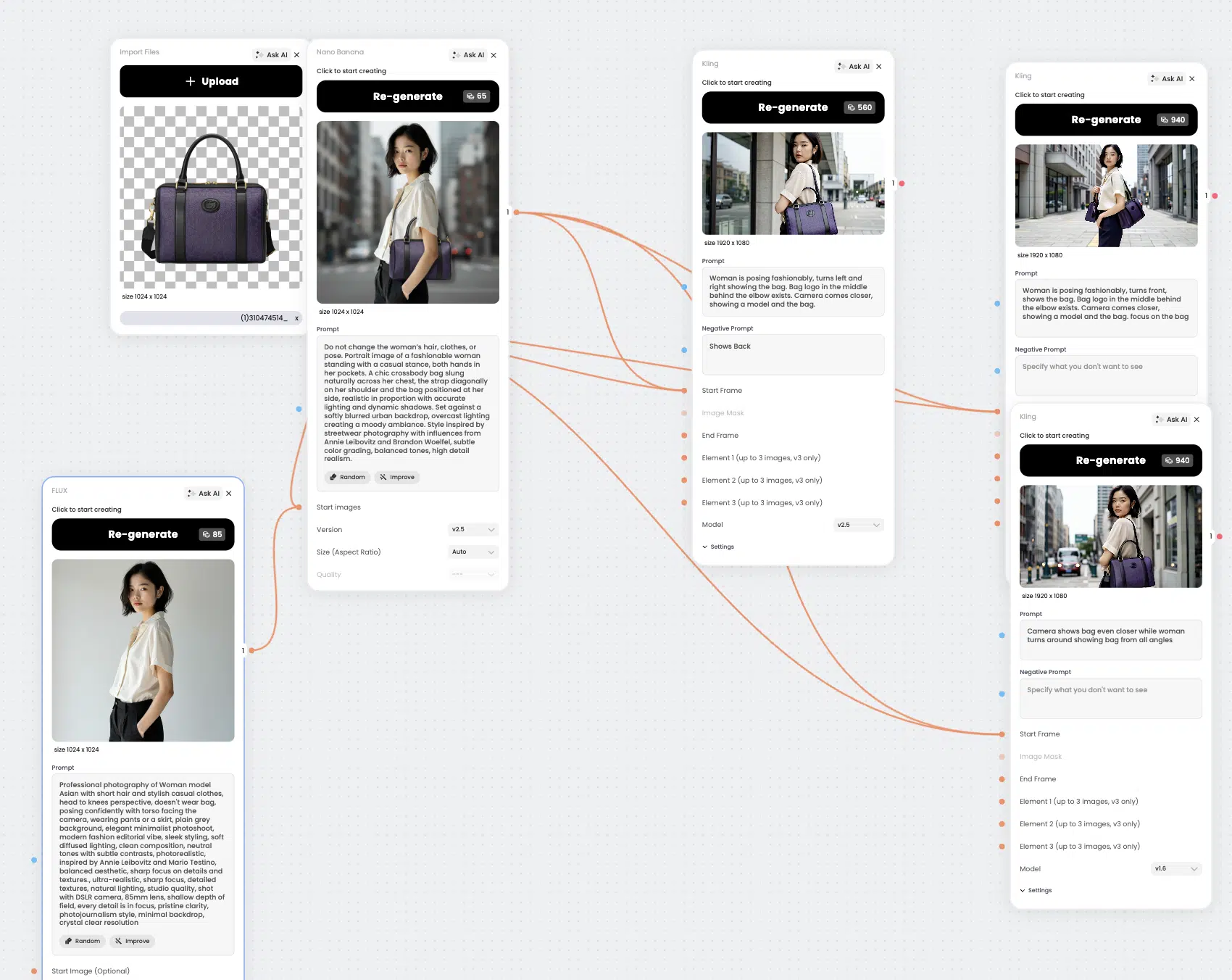
Most marketing teams do not fail because they lack ideas. They fail because production and consistency collapse under volume. Phygital+ is positioned as an AI automation platform for marketing, built around repeatable workflows rather than one-off generations.
Here is how it supports marketing systems:
- AI content automation: produce campaign visuals and creative variants quickly from a single brief
- Brand visual consistency: keep the same style across ads, social, and web assets
- Multi-channel content production: generate assets for different formats and placements
- Automation workflows: build a pipeline that your team can reuse weekly
- Scalable marketing system: reduce chaos when multiple people produce assets
Useful tool links for marketing workflows:
- Tools hub: https://phygital.plus/tools/
- Free AI advertising generator: https://phygital.plus/tools/free-ai-advertising-generator/
- Free AI image generator: https://phygital.plus/tools/ai-image-generator/
- Free AI background changer: https://phygital.plus/tools/free-ai-background-changer/
- AI infographic generator online: https://phygital.plus/tools/ai-infographic-generator-online/
- AI campaign asset generator: https://design.phygital.plus/ai-campaign-asset-generator
Practical example pipeline:
- Start with a campaign brief (audience, offer, tone, formats).
- Generate core visuals and variants.
- Create placement-specific exports (social, display, landing visuals).
- Save the workflow and reuse it for the next campaign.
- Feed results into the next round of creative.
This is where AI becomes a system, not a trick.
AI will not save a weak strategy, but it will make a strong strategy scale. Treat AI as a system: clean signals, clear objectives, repeatable workflows, and a feedback loop that turns performance into better decisions. When you build that loop, AI in digital marketing stops being a buzzword and becomes what it should be: a calmer way to ship, test, and improve without losing control of your brand.
FAQ
What is AI in digital marketing?
It is the use of artificial intelligence to analyse marketing data, personalise experiences, predict outcomes, and automate optimisation across digital channels.
How do marketers use AI digital marketing today?
Common uses include content drafting and variation, audience segmentation, predictive lead scoring, chatbot support, and AI-driven campaign optimisation in ad platforms.
How to use AI in marketing effectively?
Start with one workflow and one objective. Use AI to draft, generate variants, and summarise performance, but keep humans responsible for accuracy, brand voice, and ethical standards.
What are AI digital marketing tools?
They are tools that use AI to support marketing tasks such as content creation, automation, analytics, SEO, and customer support. The most useful way to evaluate them is by workflow category.
Can AI replace marketers?
No. AI can accelerate drafting, optimisation, and analysis, but it cannot own strategy, positioning, accountability, ethics, or human trust-building.
What are the biggest risks of AI marketing?
Publishing inaccurate content, reinforcing bias in targeting, losing brand consistency, and running “black box” optimisation without governance. Guardrails and human review reduce these risks.