AI tools for real estate agents are no longer a novelty for "techy" teams. They are making the difference between replying to leads in minutes and replying after the deal has already gone elsewhere. The real win is not a single clever prompt. It is building a system that scales listing content, visuals, follow-ups, and client communication without turning your calendar into a crime scene.
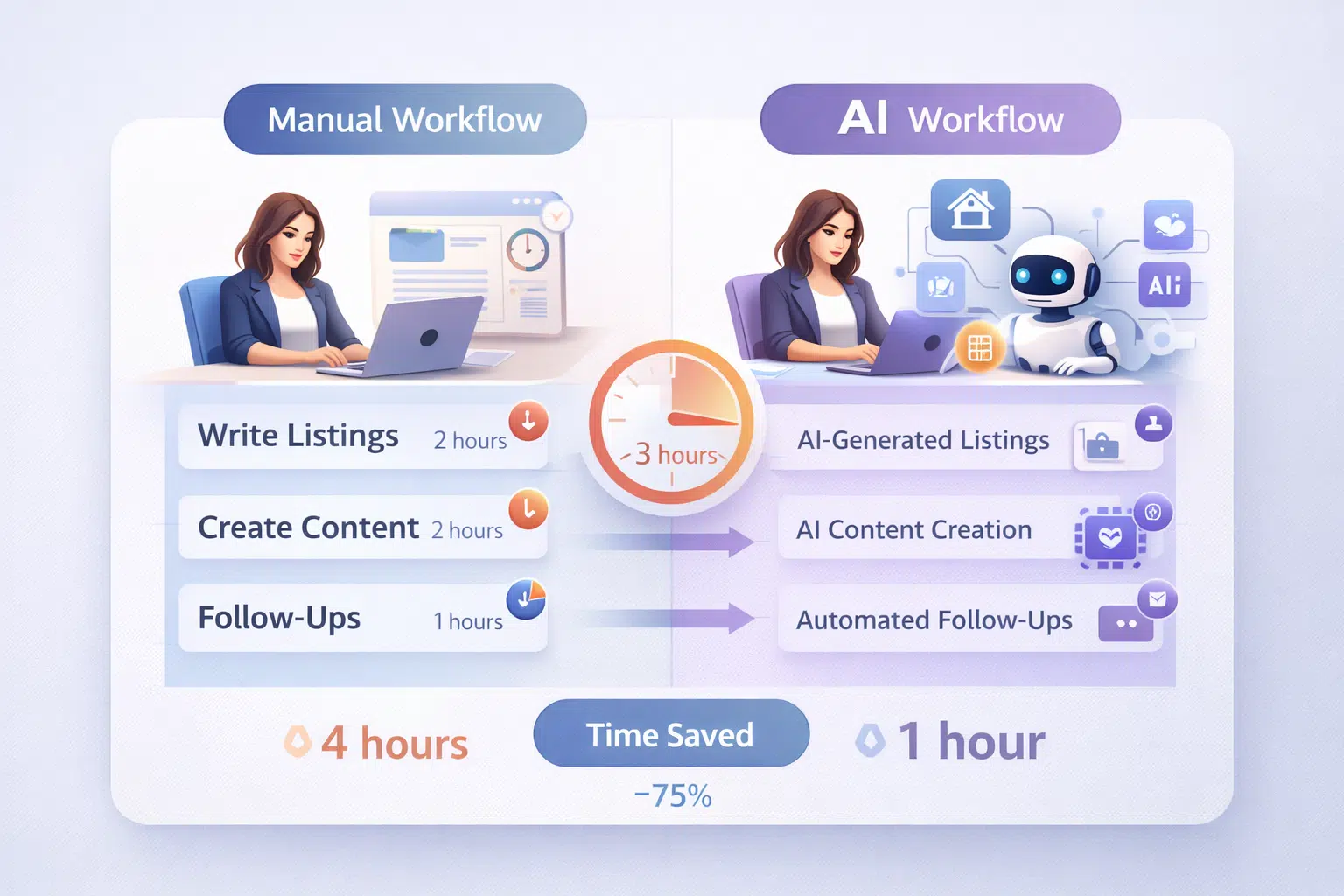
Why real estate agents are adopting AI
Real estate has always been competitive, but it is now also brutally fast. Buyers expect instant answers, sellers expect constant updates, and every platform rewards consistency. AI fits this environment because it removes friction from the parts of the job that are repetitive, urgent, and easy to standardise.
- First, lead handling is expensive, and slow follow-up burns money. If you pay for leads, you do not want them cooling off in your inbox. AI-driven chat and routing help you respond 24/7, qualify intent, and make sure you are not calling the wrong person at the wrong time.
- Second, content is a treadmill. Listings need descriptions, feature highlights, neighbourhood context, and compliant marketing copy. Social needs reels, carousels, captions, and stories. AI helps you keep output steady without writing every sentence from scratch.
- Third, visuals sell. A clean hero image, a staged living room, and a short video walkthrough do more work than a paragraph ever will. AI-powered editing, enhancement, and staging tools make that production cycle shorter.
- Fourth, there is an admin. Emails, appointment reminders, follow-up sequences, CRM updates, document checklists, and “did you get my message?” chasing. AI handles the first draft and the first touch, so you can spend your human time when it matters: negotiations, trust, and judgment.

Types of real estate AI industry tools
Think of AI as a toolbox, not a single product. You will get better results if you pick tools by workflow stage, then connect them. Below are the core categories most agents actually use.
AI for listing descriptions and marketing copy
This is the obvious category, and it is still valuable when done properly. Tools like ChatGPT or Jasper can generate listing descriptions, feature bullets, email templates, and ad copy. The trick is to feed them structured inputs (property facts, target buyer persona, key objections) and then edit for accuracy and compliance.
Use cases:
- Listing description drafts (then human polish)
- "Key features" bullet lists for portals
- Open house email invites and follow-up messages
- Facebook and Google ad copy variations
AI visualisation and AI virtual staging for real estate
Photos are the fastest way to create desire or doubt. AI visualisation covers everything from clean-up edits to full virtual staging.
This is where you will see two distinct workflows:
- Enhancement: straighten, colour-correct, remove clutter, replace a distracting background, improve lighting.
- Visualisation: show potential, not just reality, by staging an empty room or presenting style variants.
If you want a practical starting point, treat staging as “what would help a buyer imagine living here?” not “let’s turn this into a fantasy penthouse”.
AI chatbots for lead qualification
Chatbots are not there to replace you. They are there to stop you losing leads at 2 am. A good chatbot can:
- Answer basic questions (price, availability, viewing times)
- Collect contact details and preferences
- Qualify intent (buying timeline, budget range)
- Route the lead to the right agent or follow-up sequence
If your lead volume is high, this category pays for itself quickly.
AI real estate video generator and social content tools
Short video sells. It also drains time if you do it manually. Video-focused AI tools help you:
- Turn property footage into short-form edits
- Add captions, hooks, and pacing for social
- Generate scripts for voiceover walkthroughs
- Create multiple variants for different platforms
Even if you do not generate a full video from scratch, AI speeds up editing and repurposing.
AI CRM and lead generation automation
This is the “quiet” category that changes your pipeline the most. AI inside CRMs can score leads, prompt you to follow up, and automate nurture sequences. It also reduces the “sticky note problem”: leads slipping through because you got busy.
Look for:
- Lead scoring based on behaviour
- Automated follow-up sequences (email + SMS)
- Task recommendations (who to call today)
- Integrations with portals and ad platforms
AI home staging app and brand tools
Agents often underestimate how much brand consistency affects trust. An AI home staging app helps you show a property better, but a consistent visual identity helps you look reliable across listings, social, email, and ads.
This is where an AI visual identity generator (logos, icons, ad templates, colour palettes) becomes useful, especially for teams that publish a lot.


Best AI tools for real estate agents
Every tool claims it will "transform" your business. Most will just add another tab. The goal is to choose a small stack that covers content, visuals, lead handling, and automation. This table compares popular options and the scenarios where they actually make sense.
To be blunt: the best AI for real estate agents is the one that fits your workflow and you will actually use every week.
| Tool | Main function | Automation level | Solo agent fit | Agency fit | Implementation complexity | Scalability | Cost |
|---|---|---|---|---|---|---|---|
| ChatGPT | Listing copy, scripts, messages, FAQs | Medium | Yes | Yes | Low | High | Free–Paid |
| Jasper | Brand-aligned marketing copy + templates | Medium–High | Yes | Yes | Medium | High | Paid |
| Canva AI | Social and marketing design + templates | Medium | Yes | Yes | Low | High | Free–Paid |
| Runway | Video creation and editing workflows | Medium–High | Sometimes | Yes | Medium | High | Paid |
| Matterport | 3D tours, digital twins, property visualisation | Medium | Sometimes | Yes | Medium–High | High | Paid |
| Real estate CRMs with AI | Lead scoring, follow-up, pipeline automation | High | Yes | Yes | Medium–High | High | Paid |
| Phygital+ | Visual content automation + multi-tool workflows | Medium–High | Yes | Yes | Medium | High | Free–Paid |
Quick reading of the table:
- If your biggest pain is writing, start with ChatGPT or Jasper.
- If your biggest pain is social, start with Canva AI.
- If your biggest pain is video, Runway is a practical choice.
- If you sell higher-value listings, Matterport can be a differentiator.
- If you lose leads to slow follow-up, an AI-enabled CRM is the priority.
- If you need consistent visuals across channels, Phygital+ helps you standardise and scale.
How to build an AI workflow for real estate
Most agents fail with AI because they use it in random bursts. A workflow is calmer: you set inputs, outputs, and handoffs. Below is a simple structure you can adopt, then customise.
- AI generates the listing description
Start with a structured template: location, property type, key features, upgrades, transport, and the ideal buyer. Generate two versions: one portal-friendly and one social-friendly. Then edit for accuracy and fair, compliant language.
- AI creates visuals and staging variations
Use enhancement first: tidy composition, improve lighting, remove distractions. Then use visualisation for empty rooms or style refreshes. Keep staging realistic, and label it if needed.
This is where AI real estate photo editing and virtual staging can cut your production time dramatically.
- AI produces multi-channel social content
From the same property facts, generate:
- 1–2 short reels scripts
- 1 carousel outline (cover slide + feature slides + CTA)
- captions in a consistent voice
If you are learning how to use AI for real estate marketing, this is the most repeatable place to start because the inputs stay the same.
- AI automates email and messenger communication
Build pre-approved message packs:
- enquiry reply
- viewing confirmation
- post-viewing follow-up
- “still looking?” re-engagement
The point is to respond instantly, then personalise quickly.
- AI qualifies and routes leads
Use a chatbot or CRM automation to capture basics (budget, timeframe, preferred areas), then route based on priority. This stops you from spending prime hours on low-intent leads.

When AI makes the biggest impact in real estate
AI matters most when it shortens time-to-market and time-to-response. That is where you see measurable gains rather than vague "productivity" promises.
Faster listing launch
If you can publish faster, you capture demand sooner. AI helps you go from photos to description to social content in one production cycle, not a week of delays.
Higher engagement on social
Consistency wins. AI makes it easier to post regularly with a coherent style and messaging. Short-form video and carousels are especially effective when you can produce variants quickly.
Better lead conversion
Fast response and consistent follow-up are where deals are won. AI does not replace your relationship skills, but it stops you from losing opportunities because you were in a viewing.
Lower marketing costs
Better conversion means you need fewer leads to close the same number of deals. When paid leads are expensive, improving conversion is often cheaper than buying more traffic.
Agency scaling without chaos
The real “scale” story is not headcount. It is standardised processes. AI software for real estate agents works best when you treat it like a playbook: the same inputs, the same outputs, the same quality bar.
How Phygital+ helps real estate teams scale
Phygital+ is useful when your bottleneck is content production and visual consistency. Instead of juggling separate tools, you can build repeatable pipelines for listing assets and marketing creatives, then reuse them across properties.
Here is how it supports real estate workflows:
- AI content automation: generate listing visuals, ad creative, and supporting graphics in one place.
- Brand visual consistency: keep a recognisable look across all listings and channels.
- Multi-channel production: create assets for portals, social, email headers, and ads.
- Automated listing generation: produce image variations fast for different audiences.
- Workflow automation: set up repeatable steps so junior team members can execute reliably.
- Creative pipeline integration: iterate without downloading, re-uploading, and losing versions.
Practical tool links for real estate teams:
- AI listing visuals and variations: Phygital+ AI image generator
- Fast image clean-up: Phygital+ free AI background changer
- Visualisation for interiors and staging concepts: Phygital+ AI interior design tool
- Ad creative that matches your brand: Phygital+ free AI advertising generator
- Consistent identity assets: Phygital+ AI logo generator and AI icon generator
- Market snapshots and presentations: Phygital+ AI infographic generator
If you want to treat AI virtual staging for real estate as a reliable process (not a one-off experiment), a pipeline approach keeps outputs consistent.
FAQ
What are the best AI tools for realtors in 2026?
Start with one writing tool (ChatGPT or Jasper), one design tool (Canva AI), and one workflow tool for visuals and consistency (Phygital+). Add video (Runway) and 3D tours (Matterport) if they match your listing tier.
Is there one best AI for real estate agents?
Not really. The best option depends on your bottleneck: lead follow-up, content volume, photo quality, or video. Choose tools that plug into a repeatable weekly workflow.
What does AI real estate photo editing actually include?
Typically: lighting corrections, colour balance, object clean-up, background replacement, and sometimes sky replacement. The goal is to present the property accurately but professionally.
What is the difference between AI home staging app tools and virtual staging services?
Apps usually generate a staging quickly from your photo. Services often include more manual curation and tighter quality control. Apps are faster; services can be more precise.
Do I need an AI real estate video generator if I already have footage?
If you already have footage, AI is still useful for scripting, editing, captions, and creating multiple platform-specific cuts.
What is an AI visual identity generator used for in real estate?
It helps you create consistent logos, icons, banners, and templates so your listings and social content look like one brand, not random posts.
How do I learn how to use AI for real estate marketing without sounding generic?
Use your own property facts, your tone of voice, and your client FAQs as inputs. Treat AI as a draft assistant, then personalise.
Are there legal or compliance risks with AI content?
Yes. Always review copy for accuracy and ensure your ads and targeting comply with local housing and advertising rules. Keep humans in the loop for final approval.
Can AI replace an agent?
No. AI can accelerate content, follow-up, and admin. Trust, negotiation, local insight, and accountability remain human work.
Where should I start if I am overwhelmed by tools?
Pick one workflow and make it repeatable: listing description + photo enhancement + one social carousel + automated follow-up. Add tools only when the first workflow runs smoothly.
Final note: build a system, not a trick
The agents who win with AI are not the ones who generate the most text. They are the ones who build a calm, repeatable machine: faster listings, cleaner visuals, consistent brand output, and immediate lead response. Once that system exists, you can scale without losing your mind or your weekends.