What You Will Learn in This Guide
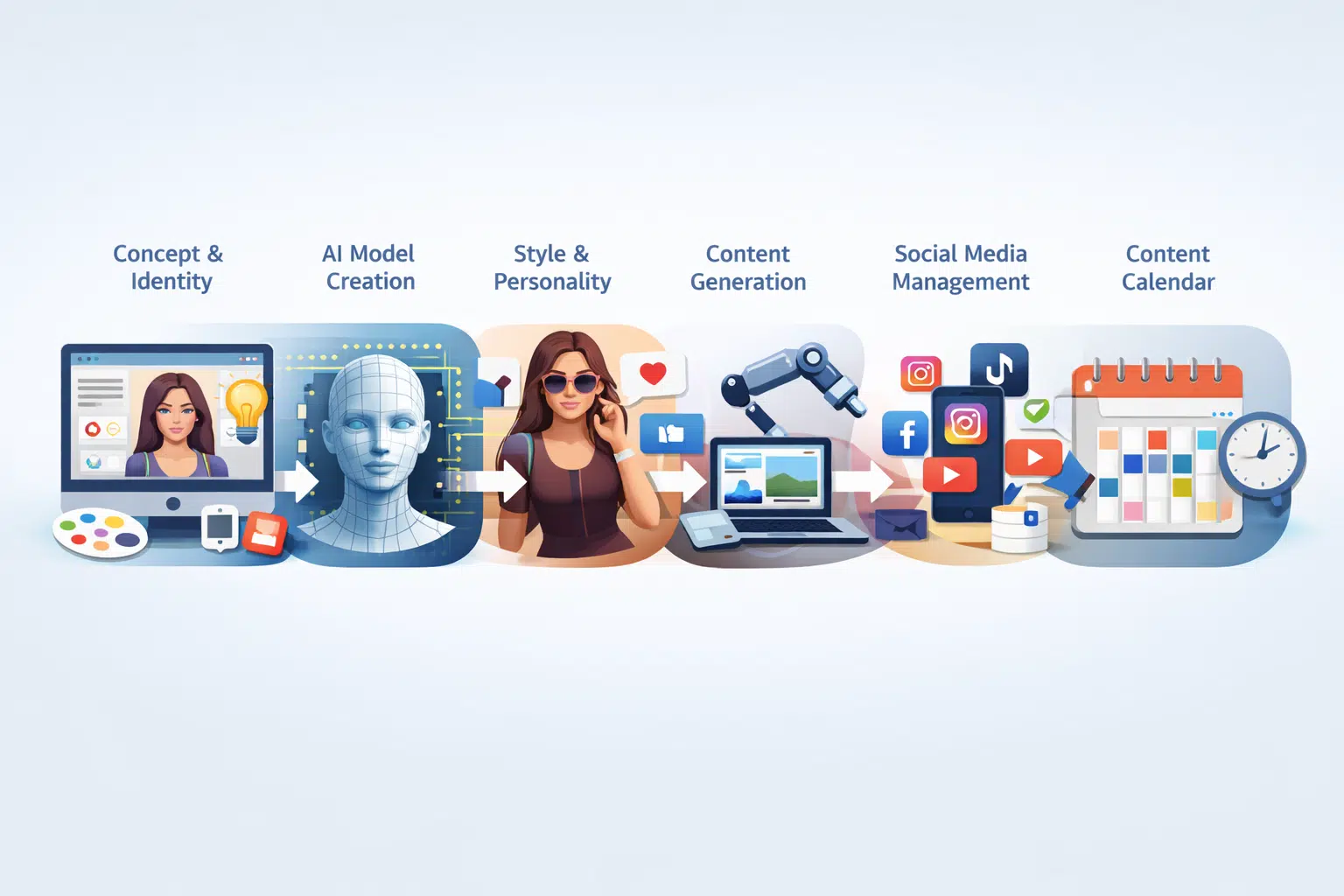
An AI-generated influencer is not “a cute character you post on Instagram sometimes.” It is a repeatable content system: a recognisable persona, a consistent visual style, and a workflow that can ship on-brand posts every week without the drama of schedules, shoots, or flaky collaborators. Influencer marketing is big business (estimated at $32.55B in 2025), and brands keep funding it because it works.
What Is an AI Social Media Influencer?
Virtual people are having a very real moment, because humans love stories and faces more than facts. A good AI influencer feels like someone you could follow, not a slideshow of random images with the same haircut.
An AI social media influencer is a digitally created persona (often photo-realistic, sometimes stylised) that posts content across platforms like Instagram, TikTok, YouTube Shorts, and X. The “AI” part can cover different layers:
- Visual generation (photos, outfits, environments, product shots)
- Video generation (talking head, motion, Reels-style clips)
- Writing (captions, scripts, comments, DMs)
- Operations (content planning, scheduling, performance tracking)
The key difference between a one-off “AI character” and an influencer is continuity. It is the same identity showing up again and again with a recognisable voice, consistent design, and a clear niche.

Why Brands Use AI-Generated Influencers
Brands do not adopt new tools because they are fun. They adopt them because budgets get tighter, timelines get shorter, and everyone still expects more content.
Here is why AI-generated influencer projects are attractive:
Lower content costs
Traditional creator content can involve negotiation, travel, reshoots, usage rights, and the “surprise, I changed my rate” tax. With an AI influencer system, you are mainly paying for tooling, creative direction, and editing time. Content becomes a production line instead of a one-off event.
Influencer marketing spend keeps growing (2026 estimate: $40.51B), so brands are actively looking for more efficient ways to produce creator-style assets at scale.
Scalability without breaking the brand
Real creators are humans, and sometimes they are chaotic. An AI influencer is not immune to bad decisions (you can still write something stupid), but you can lock the persona into strict brand rules: visual identity, tone, topics, and boundaries.
More control and fewer brand-safety surprises
No missed deadlines, no “I am taking a mental health break during your launch week,” no random public scandal. You still need ethics and disclosure, but operationally, it is a calmer system.
Always-on content production
Most brands lose momentum because content is hard to produce consistently. AI influencers are built for consistency: templates, prompt libraries, recurring formats, and multi-channel repurposing.
Note: trust can be lower with virtual influencers if audiences feel “distance” or coldness, so the strategy has to lean into transparency and strong storytelling.
How to Create Influencer AI Step by Step
If you treat this like “generate a pretty face and post it,” you will get a dead account with 17 confused followers. If you treat it like a product, you will build something that can grow.
Choose a Niche
Start with a niche that has built-in content volume and clear audience expectations. Great niches are specific enough to be memorable and broad enough to post weekly.
Examples:
- Beauty routines for sensitive skin
- Streetwear fits in Paris, Tokyo, or Milan
- Fitness for busy professionals (15-minute workouts)
- Travel micro-guides (cafes, museums, hidden spots)
- AI tools for creators (meta, but it works)
Pick:
- Platform focus (Instagram-first is common for image-heavy influencers)
- Audience (age, tastes, budget level)
- Content promise (what followers reliably get)
Pro tip: if you want fast iteration, choose a niche where “looks” matter, because visuals are your easiest leverage.
Create Personality and Backstory
People follow personalities, not render engines. To create a comprehensive AI influencer, write a one-page “character bible”:
- Name, age range, location (realistic, not over-detailed)
- Voice: playful, blunt, cosy, snarky, academic, etc.
- Values: what they promote and what they never touch
- Relationship style with followers: mentor, friend, chaotic gremlin, minimalist expert
- Signature quirks: phrases, recurring themes, rituals
- Boundaries: no political baiting, no medical claims, no impersonation of real people
Also decide disclosure style:
- Clear bio line: “Virtual creator” or “AI-generated persona”
- Clear sponsored tags when relevant

Design Visual Style
This is where most people fail. They generate 40 images and wonder why none of them look like the same person. To avoid this mistake, build a style system:
- Face anchors: eye shape, nose, freckles, skin texture, smile type
- Hair anchors: colour, cut, signature detail (streak, bangs, curls)
- Wardrobe logic: 3-5 outfit archetypes (casual, event, work, fitness, travel)
- Colour palette: 4-6 brand colours (including neutrals)
- Lighting rules: soft daylight, studio flash, neon nights, etc.
- Camera rules: lens feel (portrait vs wide), framing (close-up vs full-body)
Collect reference images (moodboard). If you want realism, consistency depends heavily on reference and constraints. In the Phygital+ app, you can attach any image references you want.
Generate Images
Now you make the actual visuals. You have two broad paths:
- High control, more setup (Stable Diffusion workflows, LoRAs, ControlNet)
- Fast results, less control (Midjourney-style prompting)
If you are on a budget and want to create an AI influencer for free, Stable Diffusion is the usual route because it is open-source, but “free” often means you pay with compute, time, and troubleshooting. If you want reliable production for business, plan for paid tools and a repeatable pipeline.
Practical generation tips:
- Use a fixed prompt prefix with identity anchors (face, hair, vibe)
- Save seeds/settings when the model supports it
- Generate “base identity set” first: 30-50 images across angles and lighting
- Create a “safe library” of approved facial expressions and poses
- Produce scenes from templates: cafe table, mirror selfie, gym shot, studio portrait
Avoid the obvious traps:
- Do not use a real person’s likeness without explicit permission
- Do not face-swap random celebrities “because it is just for fun”
- Do not over-smooth skin to plastic. Realism needs texture
If you need a tool that is built around character creation, Phygital+ has a Free AI Character maker that runs in-browser and is designed for repeated character generation.

Create a Content Plan
Influencers grow because they post consistently and repeat formats. Make a plan that looks boring on paper and powerful in execution.
Create:
- 3 content pillars (example: outfits, behind-the-scenes, product recs)
- 2 recurring series (example: “Monday fits,” “Friday favourites”)
- 1 community mechanic (polls, “help me pick,” Q&A)
- Monthly campaign slots for partnerships
Sample weekly schedule (Instagram):
- 2 Reels (15-25 seconds)
- 2 carousels (how-to or story)
- 3-5 Stories (lightweight daily touchpoints)
Track:
- Save rate (especially for carousels)
- Profile visits
- Follows per post
- Comment quality (not just count)
Some reports claim virtual influencer campaigns can achieve strong engagement, but results vary and depend heavily on authenticity and transparency.
Best AI Influencer Generator Tools
Tools are not magic wands. They are just different levels of control, cost, and effort.
Here is a practical comparison for building an AI influencer workflow:
| AI model | Control level | Cost | Complexity | Scalability | Brand-ready? |
|---|---|---|---|---|---|
| GPT Image | High | Paid | Medium | High | High |
| Imagen 4 | Medium-High | Paid | Medium | High | High* |
| Runway | Medium | Free-Paid | Low-Medium | High | High |
| Kling AI | Medium-High | Paid | Medium | High | Medium-High |
| ByteDance | Medium-High | Paid | Medium | High | Medium-High |
If you are building image-first influencer content with a decent level of control (and you are tired of your “same character” mysteriously becoming five different people), the most straightforward picks are GPT Image and Imagen 4. GPT Image is built for both generation and edits, taking text and/or an input image and returning an updated image, which makes it useful for iterative, brand-consistent variations. Imagen 4 leans hard into high-quality rendering and prompt adherence, with a reputation for stronger text/typography inside images.
If you care more about video scale (Reels/Shorts/ads) and a production pipeline that can keep up, you are looking at Runway, Kling AI, and ByteDance. Runway explicitly allows commercial use of your generated “Outputs” under its terms, which makes it one of the safer “brand-ready” options operationally. Kling AI is pushing its video model updates, signalling a focus on faster, higher-quality short-form generation. ByteDance’s Seedance 2.0 positions itself around director-level control with reference inputs and short video generation with audio, which is appealing when you need repeatable, controlled clips.
How Phygital+ Helps Create Scalable AI-Generated Influencers
Most teams fail because they cannot maintain consistency across weeks, platforms, and people, not because they cannot generate images. Phygital+ is positioned like a creative workspace: multiple models, editing, and production workflows in one browser-based system. The tools directory includes things like an AI image generator, character maker, face editing, and more.
Brand Visual Consistency
A scalable influencer needs the same “face,” the same style DNA, and repeatable outputs. Phygital+ supports model-based workflows and quick actions documentation (like upscaling, variations, inpainting) that help you keep outputs aligned instead of starting from scratch each time.
AI Content Production That Does Not Collapse at Scale
The point is not one perfect image: the main goal is to produce a month of content without losing identity cohesion. Phygital+ highlights measurable production speed improvements in its success stories (for example, “4x faster character creation with AI”), which is exactly what an influencer pipeline needs: repeatability and speed.
Multi-Channel Content and Repurposing
An influencer is a media product; you create them once, then adapt it into:
- Instagram posts and Stories
- Reels / Shorts
- Ads and banners
- Landing visuals and brand kits
Automation Mindset
Scalability comes from templates and pipelines: prompt libraries, approved style presets, and repeatable scene setups.
If you want a quick start, begin with:
- Tools hub: Phygital+ Tools
- Image generation: Free AI Image Generator
- Character identity: Free AI Character maker
CTA:
Creating an AI influencer is less “pick a face” and more “build a system.” You are designing a brand asset that can publish endlessly: a consistent identity, a controlled visual language, and a content engine that turns one creative decision into weeks of posts. The people who win here are not the ones with the prettiest first render. They are the ones who treat a virtual creator like a product: defined, repeatable, scalable, and stubbornly on-brand.
FAQ
1) Is an AI social media influencer legal?
In most cases, yes, but you must follow advertising and disclosure rules, and you should not mislead audiences. If content is sponsored, disclose clearly. FTC guidance emphasises clear brand-relationship disclosures.
2) Do I have to disclose that my influencer is AI?
There is not one single universal rule everywhere, but if not disclosing would likely mislead consumers, you should disclose. Also, transparency usually helps long-term trust.
3) How do I keep the face consistent across posts?
Use a character bible plus a controlled generation method: fixed identity anchors, reference images, consistent prompts, and workflows that support variations without identity drift. Tools designed for character creation help.
4) Can I create an AI influencer for free?
You can start with open-source tools, but “free” usually means more manual setup and compute constraints. For brand use, most teams move to paid tools for reliability and scale.
5) What is the best AI influencer generator for beginners?
If you want fast results: Midjourney-style tools. If you want deep control: Stable Diffusion workflows. If you want quick character creation in-browser, try AI Character Maker.
6) How much content should an AI influencer post?
Start with 3-5 touchpoints per week (mix posts, Stories, Reels). Consistency matters more than volume. Scale up once you see what formats drive saves and follows.
7) Can brands use AI influencers safely?
Yes, if you design guardrails: strict persona rules, disclosure policies, and content review. One study notes virtual influencers can be perceived as less warm or trustworthy, so the tone and transparency strategy matter.
8) How do I make AI influencer videos?
Use tools like HeyGen for talking-head content, and Runway for motion, scenes, and edits. Plan for a script-first workflow and repurpose the same topic across formats.
9) What is the biggest mistake people make?
They generate random, pretty images without a system. No niche, no recurring formats, no consistency, no reason to follow.
10) How can Phygital+ fit into my workflow?
Use it as Phygital+ tools hub: generate images, build character identity, iterate quickly with edits/variations, and keep assets consistent across campaigns.